

The Brutal Truth No One Tells Founders
You already know AI is important.
You’ve probably tried ChatGPT. Maybe Notion AI. Maybe you asked it to write a few emails.
And then… nothing changed.
Your inbox is still full. Your sales pipeline still moves like cold syrup. You’re still doing tasks at midnight that a $10/hour virtual assistant would handle — except now you can’t afford even that.
Here’s what most people get wrong: AI tools alone don’t transform businesses. AI systems do.
The founders winning in 2026 aren’t using more tools. They’re using connected tools — autonomous AI agents that talk to each other, execute tasks end-to-end, and hand off work like a trained team. No hand-holding. No copy-pasting between apps.
After testing over 60 AI tools built for small businesses and startups, one pattern became undeniable: the entrepreneurs saving 20+ hours per week aren’t the most technical. They’re the ones who stopped using AI as a typewriter and started using it as an operator.
This guide gives you their exact stack. The 2026 AI tools for entrepreneurs stack every founder needs before competitors build theirs.After testing over 60 AI tools for entrepreneurs and small businesses, one pattern became undeniable.
Quick Answer (Featured Snippet Target)

What are the best AI tools for entrepreneurs in 2026?
The best AI tools for entrepreneurs in 2026 include:
- Claude / GPT-4o — reasoning and content generation
- Make.com + AI modules — workflow automation
- Clay — AI-powered lead research and outreach
- Relevance AI — building custom AI agents without code
- Zapier AI — connecting apps with natural language
- Perplexity — real-time research and sourcing
- 11x / Artisan — autonomous AI SDRs for lead generation
But listing tools isn’t enough. What matters is how they connect into a system that runs without you.
What Are “AI Tools for Entrepreneurs” — Really?
The term gets thrown around loosely. Let’s be precise.
AI tools for entrepreneurs fall into three tiers:
Tier 1 — AI Assistants
These respond when you ask. ChatGPT, Claude, Gemini. Useful for drafting, thinking, summarizing. But they don’t do anything unless you do it first.
Tier 2 — AI-Powered Apps
Apps with AI baked in — Notion AI, Grammarly, Canva AI, HubSpot AI. They save time inside a task but don’t automate the task itself.
Tier 3 — AI Agents (The Real Game)
These are autonomous. You define a goal. The agent plans, executes, uses tools, and reports back. This is where the 2026 advantage lives.
Most founder guides talk about Tier 1 and 2. We’re going to give you the full picture — and show you how to build a Tier 3 system even if you’re non-technical.
Why AI Tools for Entrepreneurs Matter More in 2026 Than Ever
The market shifted fast.
In 2023, AI was a curiosity. In 2024, it was a productivity booster. In 2025, early adopters built moats. In 2026, if you don’t have an AI-automated backend, you’re competing with one hand tied behind your back. The biggest mistake founders make with AI tools for entrepreneurs is buying tools without building a connected system.
Here’s the math that should alarm you:
A solo founder using a proper AI automation stack can now:
- Research, qualify, and reach out to 500 leads/week — without a sales team
- Produce SEO-grade content consistently — without a content agency
- Onboard new clients, send updates, and follow up — without an ops hire
- Analyze performance data and suggest pivots — without a consultant
That’s not hype. That’s a Wednesday for founders using AI agents for business automation.
The ones not building this? They’re hiring humans to do what machines can do faster, cheaper, and at 3am.
The Founder Pain Stack (Why Most Entrepreneurs Are Still Stuck)
Before we get to solutions, let’s name what’s actually happening.
You wake up. You have:
- 47 unread emails (12 need responses, 35 are noise)
- A content calendar that hasn’t moved in 3 weeks
- Leads in a spreadsheet that nobody’s followed up with
- A Notion doc called “automations to build someday”
The problem isn’t motivation. It’s operational drag — low-value tasks consuming high-value time.
The fix isn’t working harder. It’s automated lead generation for startups, AI workflow automation services, and AI agents that handle the repeatable so you can focus on the irreplaceable.
Let’s build that.
The 6-Layer AI Operating System for Entrepreneurs
Think of your business as having six operational layers. Each one can be partially or fully automated with the right AI tools.
| Layer | Function | Manual Bottleneck | AI Solution |
|---|---|---|---|
| 1. Intelligence | Research, competitor analysis | Hours of browsing | Perplexity, Claude |
| 2. Lead Generation | Finding + qualifying prospects | Manual prospecting | Clay, Apollo AI |
| 3. Outreach | Emails, DMs, follow-ups | Copy-paste + CRM updates | Instantly AI, 11x |
| 4. Content | Blog, social, email marketing | Writing time | Claude, Jasper, Beehiiv AI |
| 5. Operations | Scheduling, onboarding, reports | Admin chaos | Make.com, Zapier AI |
| 6. Analysis | Metrics, decisions, pivots | Dashboard staring | Rows.ai, ChartGPT |
Most founders have patched 1–2 of these layers. The entrepreneurs pulling away have automated all six into a connected system.
The Real Cost of Not Automating (A Founder Scenario)
Meet Marcus. He runs a B2B SaaS startup with two contractors. He spends roughly:
- 8 hrs/week on lead research and outreach
- 5 hrs/week on content creation
- 4 hrs/week on client reporting
- 3 hrs/week on administrative follow-ups
That’s 20 hours per week on tasks that AI can handle — at least 70% of them.
At a conservative $100/hour opportunity cost, Marcus is leaving $8,000/month on the table. Not because AI doesn’t exist. Because he hasn’t built the system.
After implementing an AI workflow automation stack (we’ll show you exactly how in Part 3), Marcus reclaimed 16 of those 20 hours. He used them to close two new enterprise contracts.
The tools cost him $340/month total
The best AI tools for entrepreneurs in 2026 — deep breakdown.
No fluff. No generic descriptions you’ve read 40 times. Here’s what each tool actually does for founders, with real use cases.
🔬 Category 1: Research & Intelligence Tools
1. Perplexity Pro
Best for: Real-time competitor analysis, market research, sourcing
Most founders use Google like it’s 2015. Perplexity answers questions with cited sources, in real time, with follow-up capability. It’s the research assistant that doesn’t hallucinate and actually shows its work.
Founder use case: Before a sales call, ask Perplexity: “What are the top 3 pain points for Series A SaaS founders in Q1 2026?” You walk in prepared. Your competitor walks in with a pitch deck.
Pricing: ~$20/month (Pro) Verdict: Non-negotiable for any founder who needs to stay informed fast.
2. Claude (Anthropic)
Best for: Long-form reasoning, document analysis, complex strategy
Claude processes large documents — contracts, pitch decks, competitor content — and gives nuanced analysis. It reasons better on multi-step business problems than most other models.
Founder use case: Upload your last 6 months of sales call transcripts. Ask Claude: “What objections appear most frequently, and what’s the most effective counter-argument based on what worked?”
That’s a sales consultant’s job. Claude does it in 90 seconds.
Pricing: Free / Pro at ~$20/month Verdict: Your always-on strategic thinking partner.
🎯 Category 2: AI Lead Generation Tools for Startups
This is where entrepreneurs are leaving the most money on the table.
3. Clay
Best for: AI-powered lead research, enrichment, hyper-personalized outreach
Clay connects to 75+ data sources and uses AI to enrich every lead with context — company news, job changes, tech stack, LinkedIn activity. Then it writes personalized outreach for each lead automatically.
Founder use case: You want to target e-commerce founders who recently raised a seed round. Clay finds them, enriches their profiles, identifies a recent trigger (new hire, funding announcement), and drafts a first-touch email referencing it.
You review. You send. Response rates go from 2% to 12%.
Pricing: Starts at $149/month Verdict: The single best tool for automated lead generation for startups right now.
4. Instantly AI
Best for: Cold email infrastructure + AI personalization at scale
Instantly manages unlimited sending accounts, warms them up automatically, and uses AI to A/B test subject lines and body copy. It turns cold outreach from a lottery into a system.
Founder use case: Pair Clay (for lead data + copy) with Instantly (for delivery + testing). You now have an autonomous outbound engine running 24/7 while you sleep.
Pricing: ~$97/month (Growth) Verdict: Essential if outbound is part of your go-to-market.
5. 11x (Alice — AI SDR)
Best for: Fully autonomous AI sales development rep
This is Tier 3 AI in action. Alice researches prospects, writes outreach, handles replies, books meetings, and logs everything to your CRM — without human intervention.
Founder use case: A two-person startup using 11x effectively operates with the outbound capacity of a 5-person sales team. One founder closed $180K ARR in 90 days using Alice as their primary SDR.
Pricing: Custom (enterprise-tier) Verdict: High cost, high ROI. Best for founders with proven ICP and ready infrastructure.
⚙️ Category 3: AI Workflow Automation Tools
6. Make.com (formerly Integromat)
Best for: Visual workflow automation with AI modules
Make.com lets you connect any app to any other app — with logic, conditions, and now AI steps built in. It’s more flexible than Zapier and significantly cheaper at scale.
Founder use case: When a new lead fills your Typeform → Make.com enriches them via Clearbit → scores them with an AI module → if score > 70, sends a personalized email via Instantly and adds to HubSpot → notifies you on Slack.
That entire sequence runs in under 3 minutes, automatically, every time.
Pricing: Free tier / Paid from $9/month Verdict: The backbone of any AI workflow automation system.
7. Zapier AI (with AI Actions + Agents)
Best for: Non-technical founders who need automation fast
Zapier’s new AI layer lets you describe what you want in plain English. “When I get a new client email, draft a response and add the task to Asana” — and it builds the automation.
Founder use case: Perfect for founders who find Make.com’s visual builder overwhelming. You trade some flexibility for speed and simplicity.
Pricing: From $19.99/month Verdict: Best entry point for AI workflow automation services if you’re new to automation.
This makes it one of the most practical AI tools for entrepreneurs who want results without technical skills
8. Relevance AI
Best for: Building custom AI agents without code
This is AgentAutomatorAI.online’s territory. Relevance AI lets you build multi-step AI agents that use tools, call APIs, make decisions, and execute tasks end-to-end.
Founder use case: Build an “Onboarding Agent” that — when a new client signs — automatically sends the welcome email, creates their project folder in Google Drive, sets up their Slack channel, schedules the kickoff call, and populates your project management tool.
One setup. Runs forever.
Pricing: Free tier / Paid from $19/month Verdict: The most powerful no-code AI agent builder available right now.This is exactly why it ranks among the top AI tools for entrepreneurs who want results without hiring a full team.
📣 Category 4: AI Content & Marketing Tools
9. Beehiiv (with AI features)
Best for: Newsletter + content marketing automation
Beehiiv has built AI directly into its editor — subject line testing, content suggestions, send-time optimization. For founders building audience-led growth, this is the stack.
Pricing: Free / Paid from $39/month
10. Surfer SEO + Claude Combo
Best for: SEO content that actually ranks
Use Surfer to get your content brief (keyword density, structure, competitors). Use Claude to write it. The output beats generic AI content because you’re using data to guide the generation.
Pricing: Surfer ~$89/month + Claude $20/month
AI tools for entrepreneurs comparison table — 2026 edition.
The following table breaks down the best AI tools for entrepreneurs by category, price, and use case.
| Tool | Category | Best For | Pricing | Ease of Use | ROI Speed |
|---|---|---|---|---|---|
| Clay | Lead Gen | Hyper-personalized outreach | $149+/mo | Medium | Fast |
| Instantly AI | Lead Gen | Cold email at scale | $97/mo | Easy | Fast |
| 11x (Alice) | Lead Gen | Autonomous AI SDR | Custom | Easy | Medium |
| Make.com | Automation | Complex workflows | $9+/mo | Medium | Fast |
| Zapier AI | Automation | Simple automation | $20+/mo | Easy | Fast |
| Relevance AI | AI Agents | Custom agent building | $19+/mo | Medium | Medium |
| Perplexity Pro | Research | Real-time intelligence | $20/mo | Very Easy | Immediate |
| Claude Pro | Strategy | Reasoning + analysis | $20/mo | Very Easy | Immediate |
| Surfer SEO | Content | SEO-optimized content | $89/mo | Medium | Slow |
| Beehiiv | Marketing | Newsletter automation | $39+/mo | Easy | Medium |
Step-by-Step: How to Build Your AI Automation Stack (Without an Engineering Team)
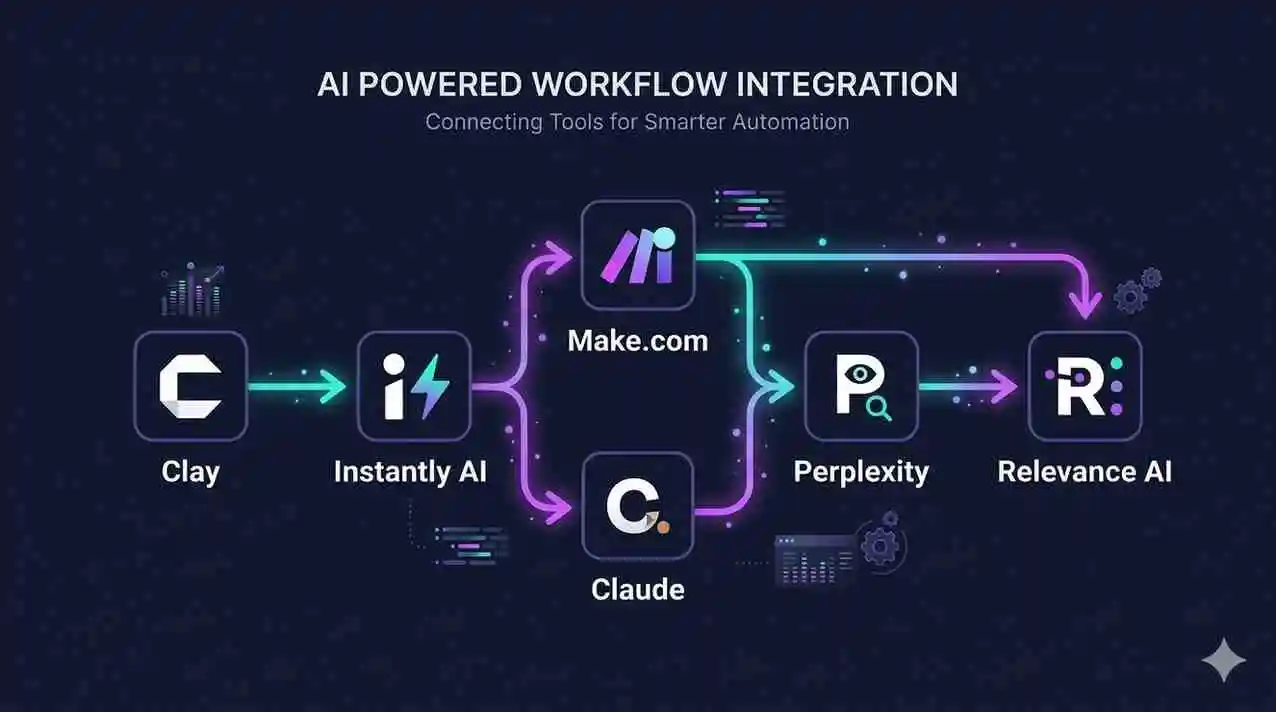
Here’s what separates founders who actually implement AI from those who just read about it.
The implementation order matters. Don’t buy ten tools at once. Build in layers.
Phase 1: Intelligence Layer (Week 1) — Cost: ~$40/month
Goal: Never walk into a meeting, call, or campaign underprepared.
Step 1: Subscribe to Perplexity Pro ($20/mo) and Claude Pro ($20/mo).
Step 2: Create a “Research Prompt Library” — a simple Notion doc with 10 prompts you use weekly:
- Competitor analysis prompt
- ICP pain point research prompt
- Sales objection analysis prompt
- Industry news digest prompt
- Prospect pre-call research prompt
Step 3: Make these prompts a habit. Before every sales call, every content piece, every pitch — run the relevant prompt. This alone saves 5+ hours/week.
Time to implement: 3 hours Time saved per week: 5–7 hours
Phase 2: Lead Generation Layer (Week 2–3) — Cost: ~$250/month
Goal: Build an outbound pipeline that runs without you.
Step 1: Set up Clay. Connect your LinkedIn Sales Navigator or Apollo account.
Step 2: Define your ICP precisely:
- Industry, company size, geography
- Job title, seniority level
- Trigger events (recent funding, new hire, tech stack change)
Step 3: Build your first Clay table. Let it enrich 200 leads with AI-generated personalization fields.
Step 4: Connect Clay → Instantly AI. Set up your sending infrastructure (minimum 3 warmed domains, 6 email accounts).
Step 5: Write 3 email sequences with Claude. Test subject lines. Launch.
Expected outcome: 200 personalized outreach emails/week, 8–15% reply rate if ICP is sharp.
Time to implement: 8–10 hours Ongoing time per week: 2–3 hours (reviewing replies, adjusting copy)
Phase 3: Operations Layer (Week 4) — Cost: ~$30/month
Goal: Eliminate the admin that’s killing your focus.
Step 1: Subscribe to Make.com (Starter plan is enough to start).
Step 2: Identify your top 3 most repetitive weekly tasks. Write them down:
- Example: “Copy new Typeform leads into HubSpot and send intro email”
- Example: “Every Monday, pull last week’s revenue data and email summary to team”
- Example: “When client pays invoice, create onboarding checklist in Notion”
Step 3: Build these three automations in Make.com. Use their template library — most common workflows are pre-built. Customize as needed.
Step 4: Add AI steps. In Make.com, you can add a “Claude” or “OpenAI” module mid-workflow to generate text, classify data, or make decisions.
Time to implement: 6–8 hours Time saved per week: 4–6 hours
Phase 4: Agent Layer (Month 2) — Cost: ~$50/month
Goal: Deploy autonomous agents for your highest-value repeatable workflows.
This is where AgentAutomatorAI.online comes in — and where most founders need guidance.
Step 1: Identify one end-to-end workflow that currently requires 3+ manual steps and human judgment. Good candidates:
- Client onboarding
- Lead qualification
- Content research + drafting
- Weekly reporting
Step 2: Open Relevance AI. Use their agent builder to map the workflow:
- What triggers it?
- What tools does it need? (email, Notion, Slack, CRM)
- What decisions does it make?
- What’s the final output?
Step 3: Build, test with 5 real examples, refine. Agents fail on edge cases — expect to spend time on this.
Step 4: Deploy and monitor for 2 weeks. Then automate the next workflow.
Realistic expectation: A properly built AI agent handles 80% of a workflow autonomously. The other 20% it escalates to you — which is still 80% of your time back.
The Full Stack Cost (Monthly)
| Tool | Monthly Cost |
|---|---|
| Claude Pro | $20 |
| Perplexity Pro | $20 |
| Make.com Starter | $9 |
| Clay Starter | $149 |
| Instantly AI Growth | $97 |
| Relevance AI | $19 |
| Total | ~$314/month |
For a founder valuing their time at $100/hour, recovering 20 hours/month covers the entire stack cost in one and a half days of reclaimed time.
Case Study: How a Solo Founder Scaled to $30K MRR Using AI Agents
Background: Sarah runs a boutique B2B content agency. One person. No full-time hires.Before picking any platform, understand that not all AI tools for entrepreneurs work the same way for every business model
Before AI Stack:
- 15 hours/week on client deliverables
- 8 hours/week on admin and ops
- 5 hours/week on lead generation
- Revenue stuck at $8K/month
What She Built (Over 6 Weeks):
- Research layer: Claude + Perplexity for all client research briefs — cut research time by 60%
- Lead gen layer: Clay + Instantly targeting CMOs at Series B SaaS companies — generating 10–15 qualified conversations/month
- Ops layer: Make.com workflows for client onboarding, invoice follow-ups, and weekly reporting
- Agent layer: A Relevance AI agent that takes a client brief → researches the topic → drafts a full content outline → formats it into a Google Doc → notifies the client to review
Results After 90 Days:
- Reclaimed 18 hours/week
- Increased capacity from 4 clients to 11 clients
- Revenue grew from $8K → $31K/month
- Still no full-time hires
The tools didn’t do it. The system did.
Sarah built her entire business around three AI tools for entrepreneurs — and hit $31K/month in 90 days.
7 Mistakes Entrepreneurs Make With AI Tools (Be Honest — You’re Probably Making #3)
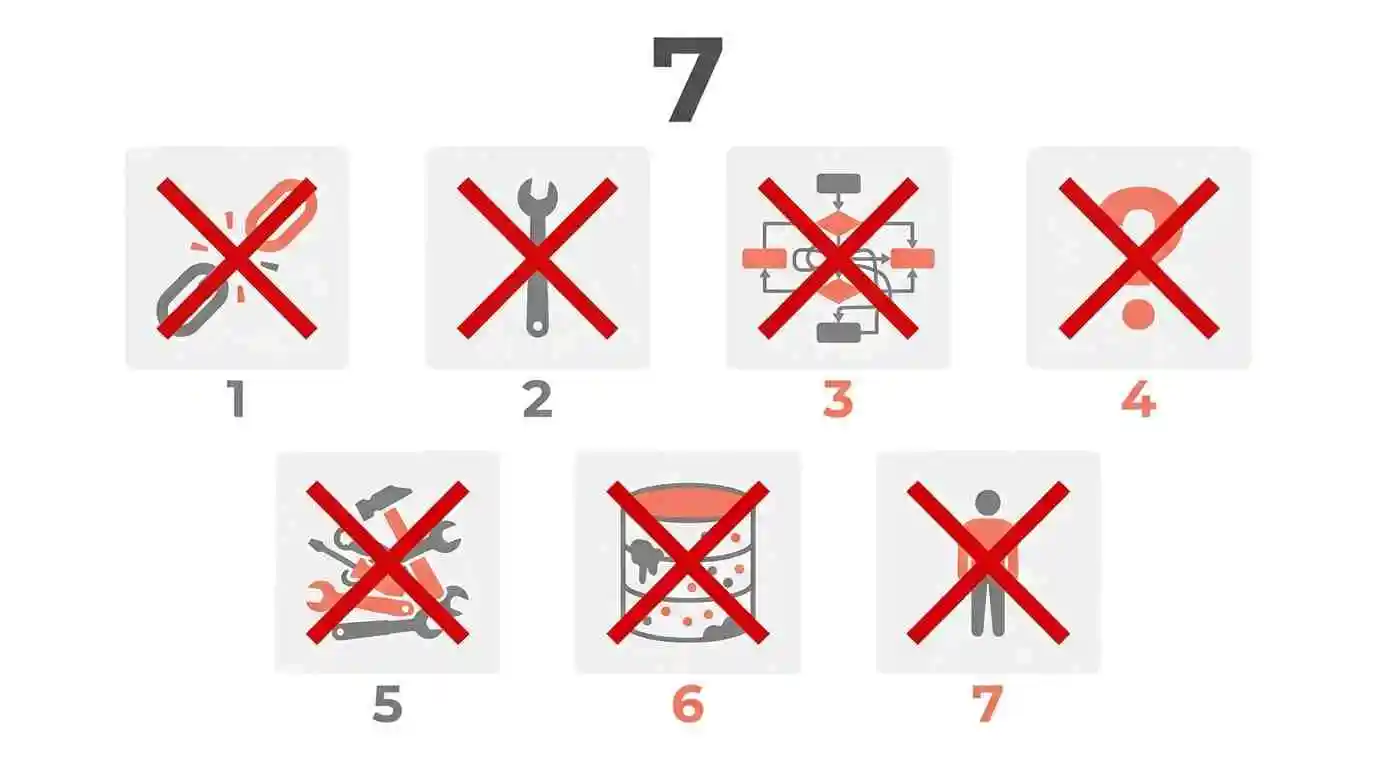
Before we dive in, understand that not all AI tools for entrepreneurs are built the same way.
Mistake 1: Treating AI like Google
Typing short, vague queries and getting frustrated at generic outputs. AI tools give back what you put in. Learn prompt engineering basics — it takes 2 hours and changes everything.
Mistake 2: Buying tools, not building systems
You don’t need 12 subscriptions. You need 5 connected tools. Integration > accumulation.
Mistake 3: Automating broken processes
This is the big one. If your sales process is unclear, automating it creates faster confusion. Fix the process on paper first. Then automate.
Mistake 4: Not defining success metrics
“Use AI more” is not a goal. “Reduce time on lead research from 8 hours to 2 hours by Friday” is. Measure before and after. Adjust.
Mistake 5: Over-relying on one tool
Founders who go all-in on one platform (usually ChatGPT) hit a ceiling fast. The stack model wins. Different tools for different layers.
Mistake 6: Ignoring data quality
AI agents are only as good as the data they work with. Dirty CRM data, inconsistent naming conventions, missing fields — these break agents. Clean your data before you automate it.
Mistake 7: Not getting expert help for complex builds
Some agents are simple. Some require prompt chaining, API connections, and error handling logic. Trying to build a complex autonomous agent without guidance wastes weeks
Advanced Strategies: What the Top 1% of AI-Powered Founders Are Doing Right Now
You’ve covered the fundamentals. Here’s what separates the builders from the readers.
Advanced Strategy 1: The “Second Brain” Agent
Most founders use Claude or ChatGPT reactively — they have a question, they ask it.
Top founders have built a persistent context system — a second brain agent that knows:
- Their ICP in detail
- Their product positioning
- Their tone of voice and brand
- Their current goals and KPIs
- Their past decisions and their outcomes
Every prompt runs through this context. Outputs are consistent, brand-aligned, and strategic — not generic.
How to build it: Create a 2,000-word “company context document.” Paste it at the start of every Claude or GPT session (or build it into a custom GPT / Claude Project). Your AI responses become 3x more relevant overnight.
Advanced Strategy 2: The Autonomous Content Engine
Scaling content without scaling headcount is the #1 competitive advantage for founder-led brands in 2026.
Here’s the flow top founders are running:
- Perplexity identifies trending topics in your niche daily
- Claude generates a full content brief with keyword targets and angle
- Claude writes the draft (with your context document loaded)
- Make.com sends it to your editor’s Notion board for light review
- Beehiiv / WordPress publishes on a schedule
One founder in the SaaS tools space is publishing 3 SEO articles per week using this stack. Zero agency. $180/month in tools.
Advanced Strategy 3: The AI-Augmented Sales Call
Before every sales call, run this 10-minute AI prep sequence:
- Perplexity: Research the prospect’s company (recent news, funding, hires)
- Claude: Analyze their LinkedIn + website and generate a “pain hypothesis” — your best guess at their top 3 operational problems
- Claude: Generate 5 discovery questions tailored to their specific context
- Claude: Draft your value proposition positioned specifically for their industry and stage
Founders using this process report close rates 2x their previous baseline. The prospect feels heard before the call even starts.
Advanced Strategy 4: The Feedback Loop Agent
Most AI automation is one-directional. Advanced founders build feedback loops:
Your outreach agent sends emails → Instantly tracks open/reply/booking rates → Make.com feeds this data into a Google Sheet → Claude analyzes weekly and suggests copy changes → You approve → Make.com updates the email sequences.
Your AI system is now learning and improving — without you micromanaging it.
This is what AI agents for business automation look like at their best. Not just execution. Iteration.
Advanced Strategy 5: Hire an AI Automation Agency Before You Need One
Here’s contrarian advice: don’t wait until you’re underwater to get help building your stack.
The best time to build AI workflow automation is before you’re at capacity — when you have the mental bandwidth to think clearly about your processes, test properly, and implement without pressure.
Founders who engage an AI workflow automation service (like AgentAutomatorAI.online) at $5K–$10K in MRR consistently reach $25K–$50K MRR faster than those who try to DIY everything at $20K–$30K when they’re drowning.
The ROI math is simple: if an automation service costs $2,000 and saves you 15 hours/month valued at $150/hour — you break even in the first month. Everything after that is profit.
View Our AI Automation Packages
The AI Entrepreneur’s Mindset Shift (The Part Most Guides Skip)
Tools don’t make you AI-powered. Thinking in systems does.
The shift looks like this:
Old thinking: “I need to write this email.” New thinking: “Who is most likely to send this email every week? Can I describe the rules clearly enough for an agent to handle it?”
Old thinking: “I should check on this lead.” New thinking: “What triggers should automatically move this lead to the next stage?”
Old thinking: “I need to hire someone for this.” New thinking: “Can I automate 70% of this role first, then hire for the 30% that requires real judgment?”
This mental shift — from task-doer to systems-architect — is what separates founders who hit $1M with a two-person team from those who need 20 people to get there.
Conclusion: Your AI Stack Is a Competitive Moat
By 2027, “do you use AI?” will be as outdated a question as “do you use email?”
The real question will be: how deeply integrated is AI into your operations?
Founders who build their AI operating system now — intelligence layer, lead generation layer, workflow automation layer, agent layer — will have:
- Lower cost structures than competitors still hiring for every function
- Faster execution on campaigns, content, and sales
- More consistent output than human-dependent processes
- Data-driven iteration that improves results automatically over time
This is not science fiction. It’s what your most dangerous competitors are building right now, this week, with the tools listed in this guide.
The question isn’t whether to build this stack. The question is whether you’ll build it before or after you wish you had.By 2027, the real question will be how deeply your AI tools for entrepreneurs stack is integrated into daily operations.
Ready to stop reading and start building?
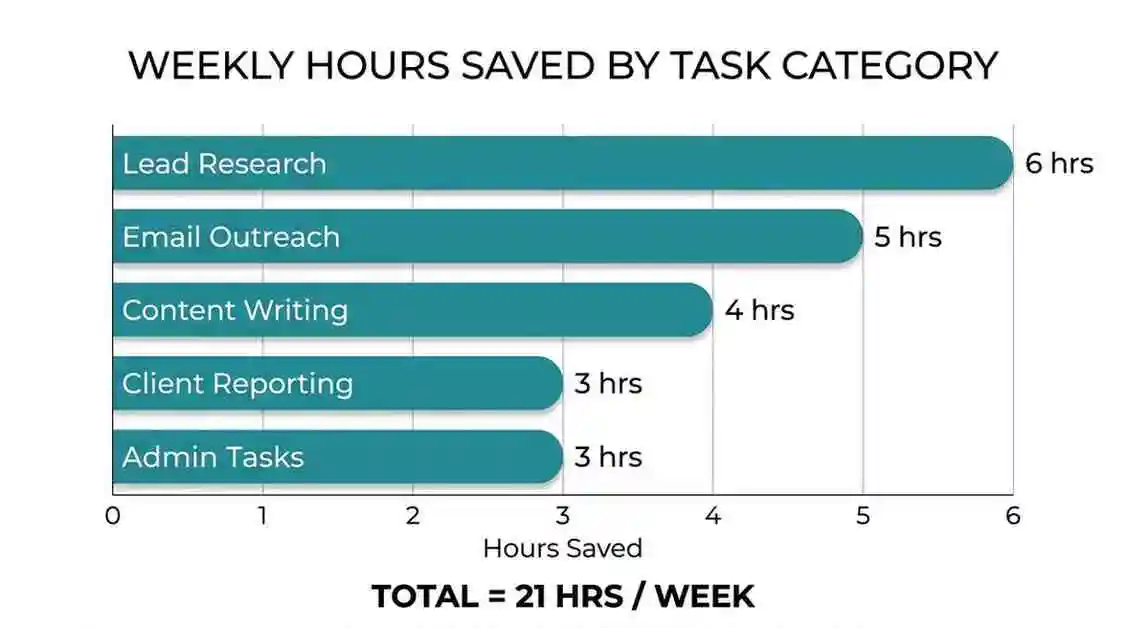
At AgentAutomatorAI.online, we build custom AI agent systems for founders and small teams — from lead generation automation to full operational workflows. We’ve helped businesses recover 20–40 hours per week and 2–5x their output without new hires. By 2027, the real question will be how deeply your AI tools for entrepreneurs stack is integrated into daily operations.
FAQ — AI Tools for Entrepreneurs
Q: What is the best AI tool for entrepreneurs in 2026?
A: There’s no single “best” tool — the highest ROI comes from a connected stack. Start with Claude Pro and Perplexity for intelligence, Clay + Instantly for lead generation, and Make.com for workflow automation. Add AI agents via Relevance AI once your core processes are defined.
Q: How much does an AI automation stack cost per month?
A: A complete founder-level stack runs $250–$400/month. This typically recovers 15–25 hours/week, making it one of the highest-ROI investments available to early-stage entrepreneurs.
Q: Can I use AI tools for lead generation without technical skills?
A: Yes. Tools like Clay, Instantly AI, and Zapier AI are designed for non-technical users. For more advanced autonomous agents, platforms like Relevance AI offer no-code builders. For complex builds, working with an AI automation agency reduces implementation time from weeks to days.
Q: What’s the difference between AI tools and AI agents?
A: AI tools respond when you prompt them. AI agents act autonomously — they take a goal, plan steps, use tools, make decisions, and complete tasks without ongoing human input. For entrepreneurs, agents are the higher-leverage investment.
Q: How long does it take to see ROI from AI automation?
A: The intelligence layer (Claude + Perplexity) delivers ROI in the first week. Lead generation automation typically shows measurable pipeline impact within 30 days. Full workflow agents take 4–8 weeks to build and stabilize, after which ROI compounds continuously.
Q: Is AI workflow automation safe for sensitive business data?
A: Most enterprise-grade tools (Claude, Make.com, Clay) offer SOC 2 compliance and data processing agreements. Always review the privacy policy for tools you connect to sensitive CRM or financial data. For highly sensitive workflows, consider on-premise or private deployment options.
Q: Should I hire an AI automation consultant or DIY?
A: DIY works well for Tier 1 and Tier 2 automation (assistant tools, simple Zapier workflows). For Tier 3 autonomous agents — especially those touching sales, client delivery, or financial data — working with a specialist like AgentAutomatorAI.online dramatically reduces implementation risk and time-to-value.