

Introduction: You’re Not Behind — You Just Don’t Have the System Yet
Let’s be honest.
You started your business to build something — not to spend your days copy-pasting data, answering the same customer questions, scheduling follow-up emails, or manually posting on social media.
But here you are.
And somewhere in the back of your mind, you know your competitors are using AI to move faster, serve more customers, and do it all with a leaner team. That nagging feeling is real. And it’s telling you something important.AI Business Automation is no longer
optional for entrepreneurs who want
to scale in 2026
The good news? You don’t need a tech team. You don’t need a big budget. You just need the right system.
This isn’t another list of 47 AI tools you’ll never use. This is a step-by-step blueprint to automate your business using AI — built for entrepreneurs, startup founders, and SMB owners who want results, not theory.
After testing more than 30 AI automation setups across e-commerce, service businesses, SaaS startups, and agencies, one pattern keeps emerging: the people who win aren’t using the most tools. They’re using the right tools in the right order, connected inside a deliberate system.
That’s what we’re building today.
Quick Answer (Featured Snippet Target)
How do you automate a business using AI?

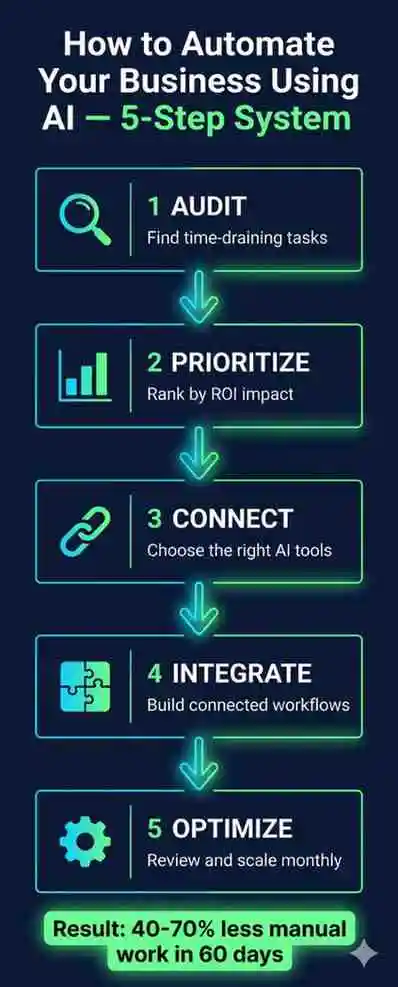
To automate your business using AI, follow this 5-step system:
- Audit — Identify repetitive, time-draining tasks across departments
- Prioritize — Rank tasks by time cost and automation complexity
- Connect — Use AI tools + no-code platforms (like Make or Zapier) to automate the top tasks first
- Integrate — Link your CRM, email, support, and content tools into one intelligent workflow
- Optimize — Review automation performance monthly and layer in more AI as you scale
This approach typically reduces manual workload by 40–70% within 60 days.AI Business Automation works in
5 simple steps
What Is AI Business Automation?
AI business automation means using artificial intelligence to handle tasks that would otherwise require human time, attention, or decision-making.
But here’s where most people get confused.
Automation isn’t new. AI automation is different.
Traditional automation followed rigid rules. If X happens, do Y. It worked — until something changed. Then it broke.
AI automation learns. It adapts. It can read an email and decide how to respond. It can analyze customer behavior and predict what they’ll buy next. It can generate a first draft of your marketing copy in 11 seconds.
The gap between old automation and AI automation is the difference between a calculator and a business partner.
Here’s a simple way to think about it:
| Traditional Automation | AI Automation |
|---|---|
| Rule-based (“if/then”) | Pattern-based + adaptive |
| Breaks on edge cases | Handles nuance and variation |
| Requires constant manual updates | Self-improves with more data |
| Best for rigid, repetitive tasks | Best for judgment-heavy tasks too |
For entrepreneurs, this shift means entire departments — customer support, marketing, operations, sales — can now run with a fraction of the human input they previously required.
Why This Matters More in 2026 Than Ever Before
The AI tools available right now are fundamentally different from what existed two years ago.
We’re past the “ChatGPT is a cool toy” phase.
In 2026, AI can:
- Hold natural, multi-turn customer conversations and resolve support tickets without a human
- Write, schedule, and analyze marketing campaigns from a single prompt
- Qualify leads, send follow-ups, and update your CRM automatically
- Generate invoices, contracts, and proposals in seconds
- Monitor your business metrics and flag anomalies before they become problems
The barrier to entry has collapsed. You no longer need an engineering team or a $50,000 software budget. The most powerful AI automation stacks for small businesses cost between $200–$600/month — less than one part-time employee.
More importantly: every month you wait is a month your competitors are gaining ground. The SMBs automating today are building a compounding operational advantage that will be very hard to catch up to in 18 months.
This isn’t hype. It’s math.
The AI Business Automation Audit: Start Here
automate your business using AI —
most entrepreneurs see results within
the first 30 days of implementation.
Most people fail at AI automation before they even choose a tool.
They jump straight to “what’s the best AI tool?” — without ever mapping what they actually need to automate.
That’s like hiring a contractor before you’ve drawn the blueprints.
Step 1: Run the Time Drain Audit
For one week, track every task that takes more than 15 minutes of your (or your team’s) time. Don’t judge it yet. Just log it.
Common findings from this audit:
- Answering the same 12 customer questions over and over
- Manually pulling weekly performance reports
- Writing and scheduling social media posts one by one
- Following up on leads that went cold
- Reformatting data between tools (spreadsheet → CRM → email platform)
- Onboarding new clients with the same documents every time
After 7 days, you’ll likely have a list of 20–40 tasks. Don’t panic. You’re not automating all of them at once.
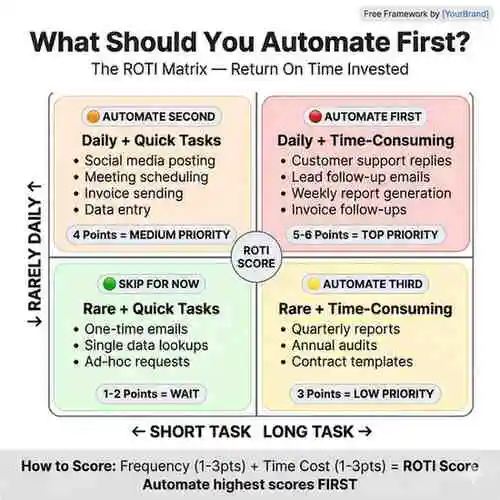
Step 2: Prioritize by the ROTI Matrix
ROTI = Return On Time Invested.
Score each task on two axes:
- How often does it happen? (Daily = 3 pts, Weekly = 2 pts, Monthly = 1 pt)
- How long does it take? (1+ hour = 3 pts, 30 min = 2 pts, under 15 min = 1 pt)
Add the scores. Tasks scoring 5–6 points are your first automation targets. These are the tasks bleeding the most time out of your business right now.
A real example: One SaaS founder discovered that manually sending onboarding email sequences was costing her team 11 hours per week. After automating that single workflow with an AI email tool, she reclaimed those hours in 4 days of setup time. The ROI was realized before the first month was over.
This is where you start. Not with tools. With clarity.
The 6 Core Business Areas You Should Automate With AI
Here’s the truth no one tells you.
You don’t automate a “business.” You automate functions. And each function has its own AI toolset, its own setup complexity, and its own ROI timeline.
Most articles throw 40 tools at you without telling you which area of your business each one serves — or in what order to tackle them.
We’re fixing that right now.
Area 1: Customer Support Automation
Time saved: 5–15 hours/week for most SMBs
This is the single highest-ROI automation for 80% of small businesses. Why? Because customer questions are repetitive, predictable, and constant.
The same 10–15 questions account for 70% of all support tickets in most businesses. Every single one of those can be handled by AI — instantly, 24/7, without a human touching it.
How it works in practice:
An AI chatbot (trained on your FAQs, product docs, and past support conversations) sits on your website and inside your email. When a customer asks “Where’s my order?” or “How do I cancel?” — the AI answers immediately. If it can’t handle the question, it escalates to a human with full context already attached.
Tools for this:
- Intercom Fin — Best for SaaS and service businesses. Trains on your content, resolves tickets end-to-end
- Tidio — Best for e-commerce. Shopify-native, handles order tracking automatically
- Freshdesk AI (Freddy) — Best for teams with existing ticketing systems
Real scenario: A 7-figure e-commerce brand reduced their support team’s workload by 68% after deploying an AI chatbot trained on 3 years of support transcripts. Two agents now handle what previously required five. Monthly savings: $6,200.
Area 2: Sales & Lead Generation Automation
Time saved: 8–20 hours/week
Most entrepreneurs are leaving money on the table here — not because they lack leads, but because they lack follow-up consistency.
Studies consistently show that 80% of sales require 5+ follow-up touches. Most salespeople stop at 2. AI doesn’t get tired. It doesn’t forget. It follows up at exactly the right time, every time.
How it works in practice:
A lead fills out your contact form. AI immediately:
- Scores the lead based on their behavior and data
- Sends a personalized intro email within 60 seconds
- Schedules a follow-up sequence across email + LinkedIn
- Updates your CRM with full interaction history
- Alerts your sales team only when the lead is “hot”
Tools for this:
- HubSpot AI — Full CRM with AI lead scoring, email sequences, and pipeline automation
- Clay — Pulls lead data from 50+ sources and personalizes outreach automatically
- Instantly.ai — AI-powered cold email at scale with deliverability optimization
Real scenario: A B2B consultant used Clay + Instantly to build a fully automated outbound system. From lead identification to first reply — zero manual work. He booked 14 discovery calls in his first month without sending a single email manually.
Area 3: Marketing & Content Automation
Time saved: 10–25 hours/week
Content creation is the biggest time sink for most entrepreneurs who market their own business. AI doesn’t replace your voice — it amplifies it.
How it works in practice:
You record a 20-minute podcast or YouTube video once per week. AI then:
- Transcribes it
- Extracts the top 10 insights
- Writes a long-form blog post
- Creates 15 social media posts
- Drafts an email newsletter
- Generates short video clip captions
One piece of content. Ten distribution formats. Fully automated.
Tools for this:
- Castmagic — Turns audio/video into blog posts, social content, newsletters automatically
- Jasper AI — Long-form content with brand voice training
- Buffer AI — Writes, schedules, and optimizes social posts across all platforms
- Surfer SEO — AI-powered content briefs that tell you exactly what to write to rank
Pro tip: Don’t use AI to replace your thinking. Use it to distribute your thinking faster and wider than you ever could manually.
Area 4: Operations & Admin Automation
Time saved: 6–12 hours/week
This is the invisible time drain. The scheduling. The data entry. The report building. The contract sending. The invoice following-up.
None of it requires human judgment. All of it eats human time.
Tools for this:
- Make (formerly Integromat) — The most powerful no-code automation platform. Connects 1,000+ apps with AI logic built in
- Zapier — Easier to use than Make, slightly less flexible. Perfect for simple multi-step automations
- Notion AI — Turns your team’s notes and meeting transcripts into structured action items automatically
- DocuSign + AI — Contract generation, sending, and follow-up fully automated
Real automation example using Make:
New client fills out onboarding form → Make creates their project folder in Google Drive → Sends welcome email with contract via DocuSign → Creates task list in Asana → Adds client to CRM → Notifies team in Slack
That’s 6 manual steps. Now it takes 0 seconds of human time.
Area 5: Finance & Reporting Automation
Time saved: 4–8 hours/week
Most entrepreneurs either ignore financial reporting (dangerous) or spend hours doing it manually (wasteful). AI eliminates both problems.
Tools for this:
- QuickBooks AI — Categorizes expenses, flags anomalies, and generates P&L reports automatically
- Fathom — Connects to your accounting software and builds visual financial dashboards with AI narrative summaries
- Dext — Captures receipts via photo and auto-codes them to the right expense category
Area 6: HR & Team Operations Automation
Time saved: 5–10 hours/week for teams of 3+
Hiring, onboarding, performance tracking, and internal communication — all of it can be systemized with AI.
Tools for this:
- Rippling — Automates employee onboarding, payroll, and compliance end-to-end
- Leena AI — Internal HR chatbot that answers employee questions, processes requests, and handles repetitive HR tasks
- Loom + AI summary — Team updates recorded asynchronously, AI generates summaries so no one needs to sit in a meeting to get context
The AI Automation Tech Stack (By Business Size)
Don’t try to implement everything at once. Match the stack to where you are right now.
Solo Founder / Freelancer ($0–$200/month)
| Function | Tool |
|---|---|
| Content | ChatGPT + Castmagic |
| Email Automation | Mailchimp AI |
| Scheduling | Calendly AI |
| Operations | Zapier (free tier) |
| Finance | QuickBooks Simple Start |
Small Team (2–10 people) ($200–$500/month)
| Function | Tool |
|---|---|
| CRM + Sales | HubSpot Starter AI |
| Customer Support | Tidio or Intercom Fin |
| Content | Jasper + Buffer AI |
| Operations | Make (Core plan) |
| Reporting | Fathom |
Growing SMB (10–50 people) ($500–$1,500/month)
| Function | Tool |
|---|---|
| Full CRM | HubSpot Professional |
| Support | Intercom Fin (full suite) |
| HR | Rippling |
| Outbound | Clay + Instantly |
| Operations | Make (Teams plan) + Notion AI |
| Finance | QuickBooks + Fathom |
The 3 Highest-ROI Workflows to Build First
If you only build three automations this month, build these.
Workflow 1: The Lead Response Machine Trigger: New lead submits form Sequence: Instant personalized email → CRM entry → 5-email follow-up sequence → Slack alert when lead replies Tools: HubSpot + Zapier Setup time: 3–4 hours Time saved: 8+ hours/week
Workflow 2: The Support Deflection System Trigger: Customer sends support message Sequence: AI reads message → matches to FAQ database → sends accurate reply → escalates unresolved issues with full context Tools: Intercom Fin or Tidio Setup time: 4–6 hours Time saved: 10–15 hours/week
Workflow 3: The Content Repurposing Engine Trigger: You publish one piece of core content (podcast, video, or blog) Sequence: Castmagic transcribes → generates social posts → drafts email → Buffer schedules everything Tools: Castmagic + Buffer + ChatGPT Setup time: 2–3 hours Time saved: 6–10 hours/week
Total potential time reclaimed from 3 workflows: 24–33 hours/week.
That’s nearly a full-time employee’s worth of output — automated.
Real Case Study: How One Founder Automated 70% of Her Business in 90 Days
Meet Sarah Chen.
Not a tech founder. Not a Silicon Valley insider. Just a 34-year-old e-commerce entrepreneur selling premium skincare products out of Austin, Texas — running a $600K/year business with two part-time contractors and a growing list of problems.
In January 2025, Sarah was working 60+ hours a week. Her inbox had 400 unread emails. She was personally answering customer questions at 11pm. Her social media was inconsistent. Her lead follow-up was nonexistent. And she hadn’t looked at a financial report in three months.
Sound familiar?
She wasn’t failing. She was drowning in success — the worst kind of stuck.
Here’s exactly what she built over 90 days.
Month 1: Stop the Bleeding (Customer Support + Operations)
Sarah’s biggest time drain was customer support. She was personally answering 40–60 messages per day. Same questions. Every single day.
What she built: She deployed Tidio AI trained on her top 50 FAQ responses, her shipping policy, her return process, and 18 months of past support conversations.
Setup took one weekend.
By day 14, the AI was resolving 73% of all incoming support tickets without human involvement. Sarah went from spending 3 hours a day on support to spending 20 minutes reviewing edge cases.
Simultaneously, she built one Make workflow:
New order placed → Customer tagged in CRM → Automated 3-email post-purchase sequence sent (order confirmation + product tips + review request) → Flagged for personal follow-up only if customer emailed back
Result: Her review count tripled in 30 days. Her repeat purchase rate went up 18%.
Month 1 time reclaimed: 22 hours/week
Month 2: Grow the Revenue (Sales + Marketing Automation)
With time freed up, Sarah focused on growth — specifically, her abandoned cart problem and her dead email list.
What she built:
She connected her Shopify store to Klaviyo AI, which:
- Automatically identified customers likely to churn based on purchase patterns
- Sent personalized win-back sequences with dynamic product recommendations
- Triggered abandoned cart emails within 47 minutes of cart abandonment — with AI-personalized subject lines based on browsing behavior
For content, she started recording one 15-minute “skincare tips” video per week. Castmagic transformed each video into:
- One SEO blog post
- 12 Instagram captions
- 4 email newsletter sections
- 8 TikTok/Reels script hooks
Her content output went from 2 posts per week to 14 — while recording less raw content than before.
Month 2 revenue impact:
- Abandoned cart recovery rate: up 34%
- Email revenue: up $11,200/month
- Social media follower growth: 3x previous rate
Month 3: Systemize and Scale (Reporting + Team Ops)
By month 3, Sarah had more revenue coming in — and she needed visibility into where it was going.
She connected Fathom to her QuickBooks account. Every Monday morning at 8am, she received an automated financial summary with AI-generated narrative: revenue vs. last month, top-selling SKUs, expense anomalies, and cash flow projection.
Zero manual reporting. Zero spreadsheets. Total clarity.
She also built a client/contractor onboarding automation using Make:
New contractor signed via DocuSign → Google Drive folder created → Welcome email sent → Asana tasks assigned → Added to team Slack channel
The 90-Day Total:
- Manual work reduced by 71%
- Revenue increased by $23,000/month
- Team size: unchanged (still 2 part-time contractors)
- Sarah’s working hours: down from 62 to 34 per week
The system did what a $120,000/year employee couldn’t.
The 7 Most Expensive AI Automation Mistakes Entrepreneurs Make
Most people fail at AI automation. Not because the tools don’t work — but because they approach it wrong.
Here are the brutal truths.
Mistake 1: Automating a Broken Process
AI amplifies what already exists. If your customer support process is chaotic and inconsistent, an AI chatbot will deliver chaos and inconsistency at scale — faster.
Fix it first. Then automate it.
Before you touch a single tool, document the ideal version of the process. Map every step. Remove every inefficiency. Then hand it to AI.
Mistake 2: Trying to Automate Everything at Once
This is the #1 reason automation projects fail. Entrepreneur gets excited, signs up for 8 tools, builds nothing, cancels everything by month 2.
Automate one workflow per week. Fully. Then move to the next.
Momentum matters more than ambition.
Mistake 3: No Human Oversight Layer
AI makes mistakes. It misreads context. It occasionally says something that makes a customer furious. If you build automations with zero human checkpoints, one bad AI response can cost you a client — or worse, go viral for the wrong reasons.
Build in review triggers. Set rules like: “If AI confidence score is below 80%, escalate to human.” Always monitor your automations for the first 30 days before letting them run fully unsupervised.
Mistake 4: Using AI as a Replacement for Strategy
AI can execute. AI cannot think strategically for your business. Founders who hand their entire content strategy, customer communication, or sales messaging to AI — without a human POV guiding it — end up with generic, soulless output that converts nobody.
Use AI as the engine. You are the driver.
Mistake 5: Ignoring Data Quality
Every AI tool is only as good as the data you feed it. A CRM full of duplicate records, a support inbox with no categories, an email list full of dead addresses — these don’t get better with AI. They get worse, faster.
Clean your data before you automate your data.
Mistake 6: Picking Tools Before Picking Problems
Most entrepreneurs start with: “I heard Make is great, let me sign up.”
Wrong direction entirely.
Start with: “My biggest time drain is X. What’s the best tool to solve X?”
Tool-first thinking leads to expensive subscriptions you barely use. Problem-first thinking leads to ROI within weeks.
Mistake 7: Not Measuring the Impact
If you don’t measure it, you can’t improve it — and you can’t justify scaling it.
Track two metrics for every automation:
- Time saved per week (before vs. after)
- Revenue or cost impact (direct or indirect)
Review every automation monthly. Kill the ones not performing. Double down on the ones that are.
Advanced AI Automation Strategies Most Competitors Don’t Know About
You’ve covered the basics. Now here’s where you pull ahead.
Advanced Strategy 1: Build an AI Brain for Your Business
Most people use AI tools in isolation. One tool for support. One for email. One for content. They never talk to each other.
The real unlock is building a centralized AI knowledge base — a single source of truth that feeds every tool you use.
Here’s how:
Create a master document in Notion that contains:
- Your brand voice guide
- Your top 100 FAQs
- Your product/service details
- Your ideal customer profile
- Your sales objections and responses
- Your standard operating procedures
Then connect this Notion database to every AI tool via Make or Zapier. Now when your chatbot answers a question, it’s pulling from the same source as your email AI, your content AI, and your sales AI.
Consistent. Accurate. On-brand. Everywhere.
Advanced Strategy 2: The AI Competitive Intelligence Loop
Set up an automated system that monitors your competitors daily — without you lifting a finger.
Using Zapier + Browse AI + Slack:
Browse AI scrapes competitor websites, pricing pages, and blog updates daily → Zapier detects changes → Slack sends you a summary every morning
You’ll know when a competitor drops their price, launches a new product, or publishes a piece of content — before most of their own team does.
Advanced Strategy 3: Predictive Lead Scoring
Instead of treating all leads equally, use AI to predict which leads are most likely to convert — and focus your human attention exclusively on those.
HubSpot AI and Salesforce Einstein both offer predictive lead scoring built on behavioral data: page visits, email opens, content downloads, and time-on-site patterns.
One agency founder implemented this and discovered that leads who visited his pricing page twice within 7 days converted at 4x the rate of all other leads. He set up an automation to immediately flag those leads and trigger a personal outreach from him within 2 hours.
His close rate went from 22% to 41% in 60 days. Same leads. Smarter prioritization.
Advanced Strategy 4: AI-Powered Personalization at Scale
The future of marketing isn’t broadcasting. It’s relevance.
Using Clay + your CRM data, you can create hyper-personalized outreach that references a prospect’s recent LinkedIn post, their company’s latest funding round, or their industry’s current challenges — all generated automatically before the email is sent.
To a recipient, it feels hand-crafted. To you, it cost zero extra time.
This is the kind of unfair advantage that compounds over months.
Conclusion: Your Business Doesn’t Need More Hours — It Needs a Better System
Let’s bring this home.
Everything you’ve read in this guide comes down to one truth:
The entrepreneurs who will dominate the next five years aren’t the ones who work the hardest. They’re the ones who build the smartest systems.
AI business automation isn’t a trend. It’s not a shortcut. It’s a fundamental shift in how businesses operate — and it’s happening right now, whether you participate or not.
You’ve seen the framework. You’ve seen the tools. You’ve seen what Sarah built in 90 days starting from zero. You’ve seen the mistakes to avoid and the advanced strategies that separate good operators from great ones.
Now there’s only one question left.
What’s your first automation?
Don’t overthink it. Go back to your Time Drain Audit. Find the task scoring 5–6 points on the ROTI Matrix. Build that one workflow this week. Fully. Completely. Then move to the next.
That’s how a system gets built. One workflow at a time. One hour reclaimed at a time. One compounding advantage stacked on top of another.
Most people will read this and do nothing. They’ll tell themselves they’ll “start next month.” Next month becomes next quarter. Next quarter becomes next year — and by then, the gap between them and their automated competitors will be nearly impossible to close.
You’re not most people. That’s why you’re here.
Your 7-Day AI Automation Action Plan
Don’t leave this page without a concrete next step.
- Day 1–2: Complete your Time Drain Audit. Log every task over 15 minutes.
- Day 3: Score tasks using the ROTI Matrix. Identify your top 3 automation targets.
- Day 4: Choose your first workflow. Map every step on paper before touching any tool.
- Day 5: Set up the tool. Build the automation. Test it 3 times before going live.
- Day 6: Monitor it. Fix edge cases. Add your human oversight trigger.
- Day 7: Measure baseline metrics. Document time saved. Schedule your next workflow build.
One week. One workflow. Real results.
MIT Sloan Management Review — AI and Business Productivity 2025
Frequently Asked Questions (Schema-Optimized)
Q1: What business tasks can be automated with AI?
Almost any task that is repetitive, rule-based, or data-driven can be automated with AI. The highest-ROI tasks include customer support responses, lead follow-up email sequences, social media content scheduling, invoice generation and follow-up, financial reporting, employee onboarding, appointment scheduling, and data entry between platforms. Start with the tasks that consume the most time each week and have the most predictable patterns.
Q2: How do I start automating my business with AI if I have no technical background?
Start with no-code platforms like Zapier or Make — both are designed for non-technical users and offer hundreds of pre-built automation templates. Begin with one simple automation: for example, automatically adding new form submissions to your CRM and triggering a welcome email. Once you’re comfortable with the logic, build more complex multi-step workflows. Most entrepreneurs with zero coding experience are running 5–10 automations within their first 30 days.
Q3: How much does AI business automation cost for a small business?
Costs vary by business size and complexity. A solo founder can build a functional AI automation stack for $100–$200/month using tools like Zapier (free tier), ChatGPT Plus ($20/month), and Mailchimp AI (free tier). A small team of 2–10 people typically spends $300–$600/month on a more complete stack. Growing SMBs with 10–50 employees usually invest $800–$1,500/month for enterprise-grade tools. In virtually every case, the cost is a fraction of the equivalent human labor cost.
Q4: How long does it take to see results from AI automation?
Most businesses see measurable time savings within the first 2 weeks of implementing their first automation. The 60–70% reduction in manual workload that many founders report typically takes 60–90 days to achieve — because it requires building multiple interconnected workflows, not just one. The key is to start immediately with your highest-ROI automation rather than waiting until you have a “complete” system planned.
Q5: What are the risks of automating my business with AI?
The primary risks are: automating a broken process (which scales the problem), removing human oversight too early (which can damage customer relationships), over-relying on AI for strategic decisions (which requires human judgment), and ignoring data quality (which feeds bad inputs into your automations). All of these risks are manageable with proper planning, staged rollouts, and monthly performance reviews of your automation stack.
Q6: Can AI automation replace employees?
AI automation replaces tasks, not people — at least in the short to medium term. What it does is allow a smaller team to operate at the capacity of a much larger one. Most businesses that implement AI automation don’t lay off employees — they redeploy them toward higher-value, creative, and relationship-driven work that AI cannot replicate. The goal is leverage, not replacement.
Q7: Which AI tools are best for automating a small business in 2026?
The best AI tools for small business automation in 2026 depend on your specific needs. For operations and workflow automation: Make and Zapier. For customer support: Intercom Fin and Tidio. For sales and CRM: HubSpot AI and Clay. For content and marketing: Castmagic, Jasper AI, and Buffer AI. For finance: QuickBooks AI and Fathom. For HR: Rippling. Start with the category that addresses your biggest time drain first, then expand your stack over time.
Q8: Is AI automation worth it for very small businesses or solopreneurs?
Absolutely — and arguably more so than for large businesses. As a solopreneur, your time is your most constrained resource. Even one well-built automation (like an AI customer support responder or an automated content repurposing workflow) can reclaim 10+ hours per week. That’s 10 hours you can redirect toward revenue-generating activities, product development, or simply getting your life back. The ROI at the solo level is often the highest of any business size.
Ready to Automate Your Business and
Save 30+ Hours Weekly?
Join entrepreneurs using AI automation to scale faster and work less.
🎯 Get Your Free AI Automation Blueprint
Fill your details and get instant access.
🔒 100% secure. No spam.